
The G20's Bali Declaration Wednesday acknowledged differences among members on the Russia-Ukraine war but said it was essential to adhere to international law, including protection of civilians caught in conflicts.

However, the details of the meeting were not officially confirmed.

The prime minister will leave for the Indonesian city of Bali on Monday on a three-day visit to attend the summit that is expected to deliberate extensively on pressing global challenges including the Ukraine conflict and its implications.

Russian Foreign Minister Sergey Lavrov and Defence Minister Sergey Shoigu will visit India to hold the inaugural '2+2' ministerial dialogue between the two countries on December 6, the Russian embassy has said.

"India has consistently articulated its desire to play a more constructive and meaningful role as an observer at the SCO," External Affairs Minister S M Krishna said, addressing the 10th summit of the forum in the Uzbek capital of Tashkent.
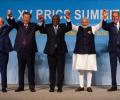
'Victims of terrorism do not sit together with its perpetrators to discuss terrorism.'

India seeks to play a supportive role for a peaceful and stable region, Prime Minister Narendra Modi said on Monday as he embarked on a high-profile visit to Russia to hold summit talks with President Vladimir Putin amid the conflict in Ukraine.
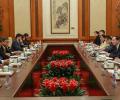
In the talks, China emphasised that the two sides should proceed from the fundamental interests of China, India and adhere to the strategic height and long-term perspective of China-India relations, the readout said.
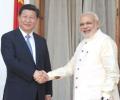
The summit is being seen as an effort by India and China to rebuild trust and improve ties that were hit by the 73-day-long Doklam standoff last year.

India and China will complete the disengagement process in the Gogra-Hotsprings area in eastern Ladakh by September 12, the External Affairs Ministry said on Friday.

'If an 'informal meeting' with Xi Jinping materialises before the SCO summit in June, that itself could be regarded as a significant breakthrough in India-China relations,' says Ambassador M K Bhadrakumar.

Though the two-day SCO Council of Foreign Ministers' meeting began at the Taj Exotica Resort in Benaulim on Thursday evening with a reception hosted by Jaishankar, the main deliberations took place on Friday.

Former external affairs minister Salman Khurshid on Sunday said that the NDA govt has a great inclination of pulling rabbits out of hats.

Jaishankar said that both sides also exchanged views on the next steps in the India-China bilateral ties.

We have seen great strides in all-around cooperation, Chinese foreign ministry spokesperson said.

'With continued focus on votes, upcoming by-polls and purchasing politicians, the political hierarchy has little time for national defence.' 'They would do well to heed a veteran scholar, who says, "There will be war with China in the next few years. The next full scale war will have the involvement of Pakistan and terror elements, insurgents and intelligence assets operating inside India",' warns Lieutenant General Prakash Katoch (retd).
Mr Modi might have questions to ask himself on the most formidable strategic challenge before India that he inherited from the United Progressive Alliance: The triangulation between China and Pakistan. The failure to break out of it, or even loosen it a bit, is something to reflect on, notes Shekhar Gupta.

Defence Minister Rajnath Singh is likely to hold bilateral talks with his Chinese counterpart Li Shangfu on the sidelines of the SCO defence ministerial conclave in Delhi, people familiar with the matter said.
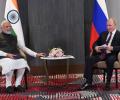
The phone conversation came days after it emerged that Modi will not be travelling to Russia for the annual India-Russia summit this year.

'Problems will keep recurring unless China vows to resolve all outstanding issues between the two sides,' says Sana Hashmi.

China does not have to give up what it took in 2020, it will never give up its claim to Arunachal Pradesh, Ladakh and other areas, and it has all the time now to plan its next surprise, points out Lieutenant General Prakash Katoch (retd).

India requested Pakistan to let Modi's aircraft fly over its airspace to Bishkek in Kyrgyzstan.

Days after Prime Minister Narendra Damodardas Modi and China's President Xi Jinping expressed their concerns about the war in Ukraine with Russian President Vladimir Putin at the SCO summit in Samarkhand, the tyrant of the Kremlin has raised the military stakes in the conflict.
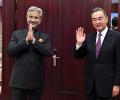
China is ready to take "conciliatory steps" in order to avoid new violations of the obligations on the India-Chinese border, Chinese Foreign Minister Wang Yi said on Friday, a day after holding a crucial meeting with External Affairs Minister S Jaishankar over the current standoff in Ladakh. Speaking during a joint press conference with Russian Foreign Minister Sergey Lavrov, Wang said troops and equipment should be withdrawn from the Line of Actual Control (LAC).
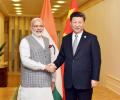
The meeting, which lasted for nearly 50-minutes, comes in the backdrop of stiff Chinese opposition to India's entry into the NSG, which looks after critical issues relating to nuclear sector, including trade and export of nuclear technology.

China on Monday said India's membership bid in the NSG has become "more complicated" under the "new circumstances" as it again ruled out backing New Delhi's entry in the grouping, saying there should be non-discriminatory solution applicable to all non-NPT signatory countries.
Dar also said Pakistan views Russia as an important player in the West, South and Central Asia, and strengthening mutually beneficial cooperation with Russia remains an important priority for Pakistan's foreign policy.

It would be the highest level visit to India by any Pakistani leader in recent years and a possible opportunity to break the ice between the two nations.
If the visit takes place, it will be the first trip by a senior Chinese leader to India after the eastern Ladakh standoff between the two countries began in May 2020.

External Affairs Minister S Jaishankar is set to hold separate bilateral talks with his Chinese counterpart Qin Gang and Russia's Sergey Lavrov at a beach resort in Goa on Thursday on the sidelines of a conclave of the Shanghai Cooperation Organisation (SCO) amid rapidly evolving regional security situation.

India on Friday sought resolute and comprehensive global action against terror infrastructure, saying the challenge must be taken seriously as different "theatres" are getting interconnected through terror networks as well as globalisation of the "supply chain of ideology".

Prime Minister Narendra Modi on Wednesday gifted Kazakh President Nursultan Nazarbayev a set of books relating to religions born in India.
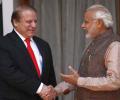
Modi enquired about Sharif, his mother and family.

India would not be seen to be anything but rude with the Pakistanis. In the big picture, who is the bigger adversary right now? Who is the bigger pain in the neck? And who is it that is keeping more than 3,000 km of our borders active, throwing our military posture and deployments into imbalance? asks Shekhar Gupta.

In their first structured bilateral talks in nearly five years, Prime Minister Narendra Modi and Chinese President Xi Jinping Wednesday agreed that India and China can have a 'peaceful and stable' relationship by displaying maturity and mutual respect and endorsed the pact on the resolution of the dragging eastern Ladakh border row.

New Delhi has reached out to Moscow while waiting for a new president in Washington. New Delhi knows well that in international relations, there are no permanent friends or foes, only permanent national interests, points out Dr Rup Narayan Das.
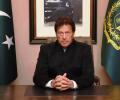
This is the second time after Modi was re-elected to power that the Pakistani premier has expressed his desire to work together with India for the betterment of their peoples.
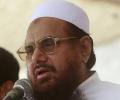
Jammat-ud-Dawah chief and Mumbai attack mastermind Hafiz Saeed on Tuesday warned Pakistan Prime Minister Nawaz Sharif against extending a hand of friendship to India.

India says it cannot accept a project that ignores its core concerns on sovereignty and territorial integrity.

India and China on Wednesday held 'constructive' and 'forward-looking' diplomatic talks to resolve the over four-year border standoff along the Line of Actual Control (LAC) in eastern Ladakh but there was clear no indication of any breakthrough.
